1. Plan by volume
Models are sorted by carton size, then assigned to container zones.
Home / Loading
Desks, chairs, teacher desks and lockers load together. What makes it work is not a clever packing trick — it is planning the load from measured cartons, not from a brochure.
Container volume is a ceiling, not a target. We work from three variables and calculate, we do not estimate:
The result is specific to your mix of models. A quote without a loading plan is a guess.
Because it changes with the mix. A container of Z011 C-legs carries more than the same container of Z013 with 650×450 tops.
Publishing one number would be accurate for one model and wrong for the rest.
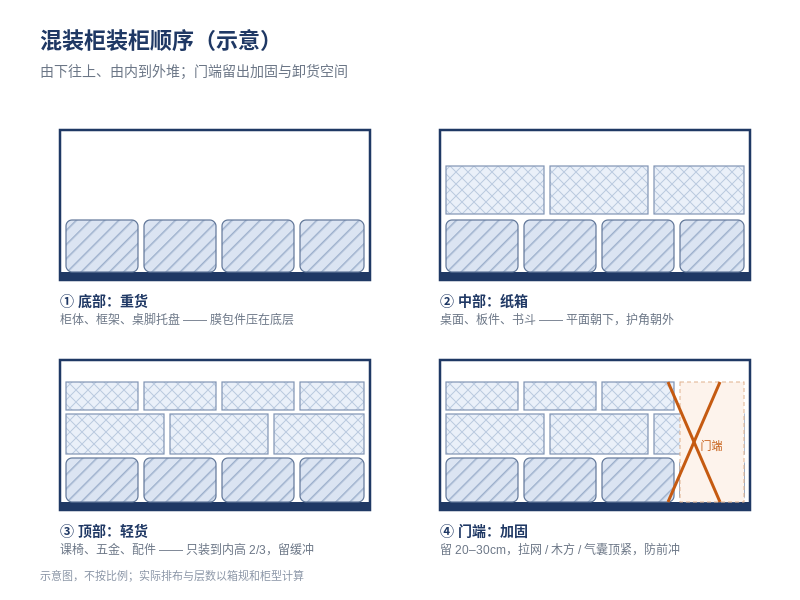
Models are sorted by carton size, then assigned to container zones.
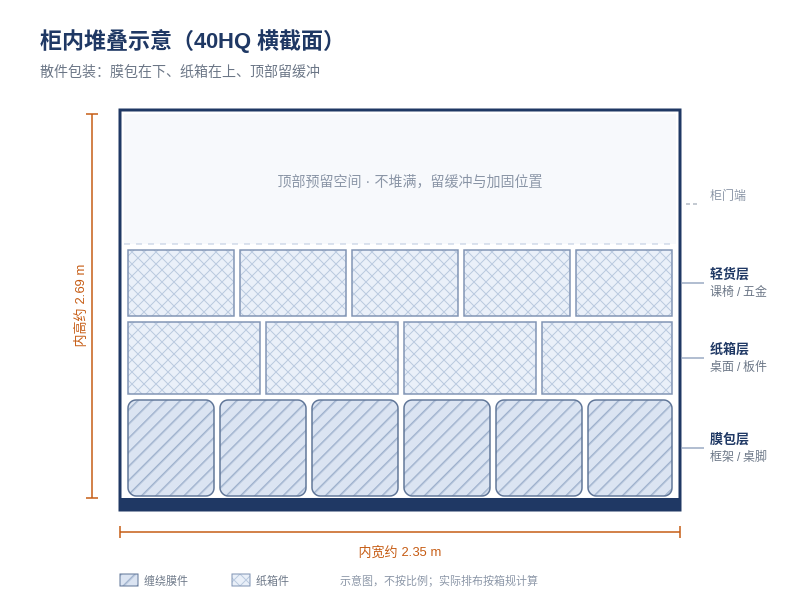
Frame cartons at the floor, tops and lockers above, nothing crushing a carton edge.
Cartons carry room numbers, so unloading happens by classroom, not by SKU.
Before the doors close, photos go to you with the container number.
| Part | Packing | Why |
|---|---|---|
| Tops, boards, locker panels | Carton, corner protected | Edge damage is the most common transport defect |
| Frames, legs, cross rails | Stretch film wrap | Saves volume on hollow tube; steel does not need a carton |
| Screws, caps, adjusters | Bag per set, labelled by model | Nothing mixed on site |
| Labels | Room number + model + quantity | Unload classroom by classroom |
Film wrap is not free of risk. It saves volume, but steel frames can rub through the film on a long sea route. We wrap corners and strap the bundle; if your route is long, ask for cartons on the frames instead — it costs volume, not quality.
Send the model mix and quantity; the plan comes with the price.